My entire DIY cleaning setup, and what it actually cost
Everything I bought once, the recipes I make weekly, and the honest math on whether DIY cleaning is actually cheaper.
The honest pitch: I switched to mostly DIY cleaning two years ago. Not because I was chasing perfection, but because I got tired of buying $5-7 sprays in plastic bottles with noxious odors and hauling them home from the store.
This is the full setup, every bottle, every ingredient, every tool. Nothing is sponsored, everything is what I actually use. I’ll show you what I bought, what it cost, what I make with it, and where I still cheat (yes, bleach is in here).
Why DIY cleaning, honestly
Three reasons, in order of how much they actually motivated me:
- Aesthetic. A row of matching amber glass bottles on a shelf is genuinely calming. A cabinet full of mismatched plastic spray bottles with garish labels is not.
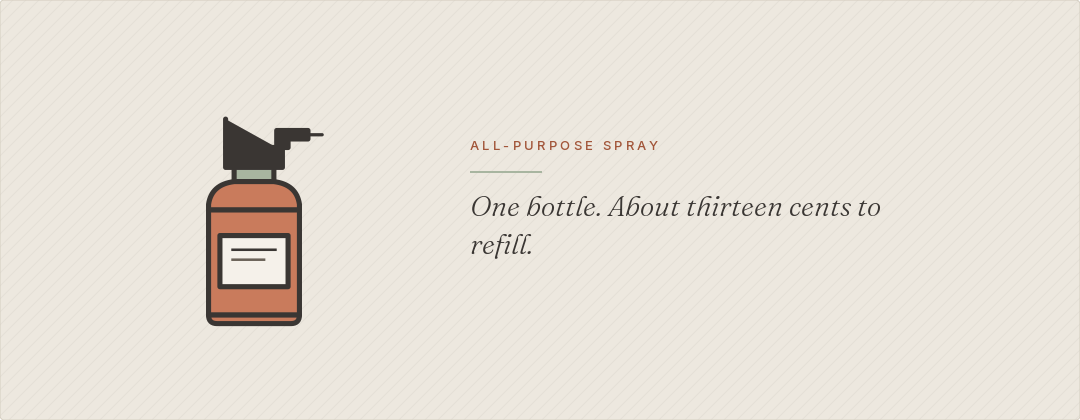
- Money. A gallon of white vinegar costs $4 and makes about 30 bottles of all-purpose cleaner. That’s roughly $0.13 per bottle versus $5-8 for the store version.
- Ingredients. I read the back of a Method spray once and didn’t recognize four of the ingredients. Some of the fragrance was also bothersome. Now I know exactly what’s in everything.
That third one is the real long-term reason. The first two got me started.
The one-time setup (~$80-120 total)
This is the upfront cost. After this, you’re just buying pantry ingredients.
Glass bottles: the foundation
I use amber glass spray bottles because clear glass lets light degrade essential oils, and plastic absorbs cleaning solutions over time (yes, even the “good” plastic). Amber is the standard for a reason.
What I bought:
- A set of 6 16oz amber glass spray bottles
- A set of 4 8oz amber glass bottles for smaller mixes
Real talk: Don’t cheap out on the spray triggers. The $5 sets on Amazon have triggers that fail in 3 months. Spend the extra few dollars for ones with stainless steel springs.
Total: ~$35-45
Foaming hand soap dispensers
These are the secret weapon. A foaming pump turns one part Castile soap + four parts water into a luxurious hand soap. One $16 bottle of Castile soap will refill these for about a year.
What I bought:
- 2 glass foaming dispensers (one for kitchen sink, one for bathroom)
Total: ~$25-30
A label maker (or just stickers)
If you don’t label your bottles, you will absolutely spray glass cleaner on your face thinking it’s the linen mist. Ask me how I know.
Two options:
- A small thermal label maker like the Phomemo P12 (~$30) prints clean white labels with adhesive backing. Lasts forever, you’ll use it for everything else in your house too.
- Pre-made minimalist cleaning labels from Etsy if you want zero effort (~$8-15)
Total: ~$15-30
A few small tools
- Funnel set: you’ll use these every single time you refill a bottle. $8.
- A dedicated set of measuring spoons for cleaning: keep them separate from your kitchen ones. $6.
- A small whisk or stir stick: for mixing baking soda solutions.
Total: ~$15-20
The pantry ingredients (~$40 to start, much cheaper to maintain)
These are the building blocks. With these eight ingredients, you can make every cleaner I use.
| Ingredient | Approx. cost | What it does |
|---|---|---|
| White vinegar (gallon) | $4 | All-purpose, glass, descaling |
| Baking soda (13lb bag) | $10 | Scrub, deodorize, soft scour |
| Washing soda (Arm & Hammer) | $5 | Heavy-duty cleaning, laundry boost |
| Castile soap (Dr. Bronner’s, 32oz) | $16 | Hand soap, dish soap, floor cleaner |
| Hydrogen peroxide (32oz) | $3 | Disinfecting, stain removal |
| Citric acid (1lb) | $8 | Descaling, toilet bowl cleaner |
| Tea tree essential oil | $10 | Antimicrobial, scent |
| Lemon essential oil | $8 | Cuts grease, scent |
Important note: Washing soda and baking soda are not the same thing. Washing soda (sodium carbonate) is much stronger and more alkaline. Don’t substitute.
One-time pantry total: ~$64
After that, you’re replacing maybe $15-20 worth of ingredients every 3-4 months. That’s it.

My recipes (every one I actually use)
I keep these printed and laminated inside my cleaning cabinet door. Here they are.
All-purpose spray (the workhorse)
In a 16oz amber spray bottle:
- 1 cup water
- 1 cup white vinegar
- 10 drops lemon essential oil
- 5 drops tea tree essential oil
Shake before use. Don’t use on natural stone (granite, marble), the vinegar etches it. Everything else is fair game.
Glass and mirror cleaner
In a 16oz amber spray bottle:
- 1.5 cups water
- 0.5 cup white vinegar
- 1 tbsp rubbing alcohol (helps with streaking)
- 2-3 drops lemon essential oil
Use with a microfiber cloth, not paper towels. Streak-free, no fumes.
Soft scrub (for tubs, sinks, stovetops)
In a small jar or 8oz container:
- 1 cup baking soda
- ¼ cup Castile soap
- 1 tbsp water
- 5 drops lemon essential oil
Mix to a paste. Apply, let sit 5 minutes, scrub, rinse. Replaces Comet, Soft Scrub, and most “miracle” pastes.
Floor cleaner
In a bucket:
- 1 gallon hot water
- ¼ cup white vinegar
- 1 tbsp Castile soap
- 5 drops tea tree oil
Works on tile, sealed wood, vinyl, and laminate. For unsealed wood, skip the vinegar.
Toilet bowl cleaner
In a small jar:
- ½ cup baking soda
- 10 drops tea tree oil
Sprinkle in the bowl, then pour in 1 cup of white vinegar. Let it fizz for 10 minutes, scrub, flush. (See the “what about bleach” section below for the honest caveat here.)
Foaming hand soap
In an 8oz foaming dispenser:
- 1.5 oz Castile soap (any scent, peppermint and lavender are my favorites)
- Fill the rest with water
- Optional: 5 drops of essential oil
Critical: Add the soap first, then the water. Reverse and you’ll create bubbles that won’t let you fill it.
What I still use bleach for (the honest part)
I use diluted bleach for toilets occasionally, specifically when something has been sitting too long or there’s a stain the citric acid can’t handle. About once a month.
I’m not going to pretend I’ve replaced 100% of conventional cleaners. Anyone telling you they have, in a real household with real life happening, is selling you something.
What I’ve actually replaced bleach with for everything else:
- Disinfecting countertops: hydrogen peroxide in a dark spray bottle (light degrades it, must be amber or cobalt glass)
- Laundry whitening: ½ cup hydrogen peroxide in the wash + sun-drying
- Mold/mildew on grout: baking soda paste + tea tree oil
The toilets are the holdout. I’m okay with that. Progress over purity.
Tools and gear that make it work
These aren’t strictly necessary, but they’re what made DIY cleaning stick for me instead of becoming a thing I tried for two weeks.
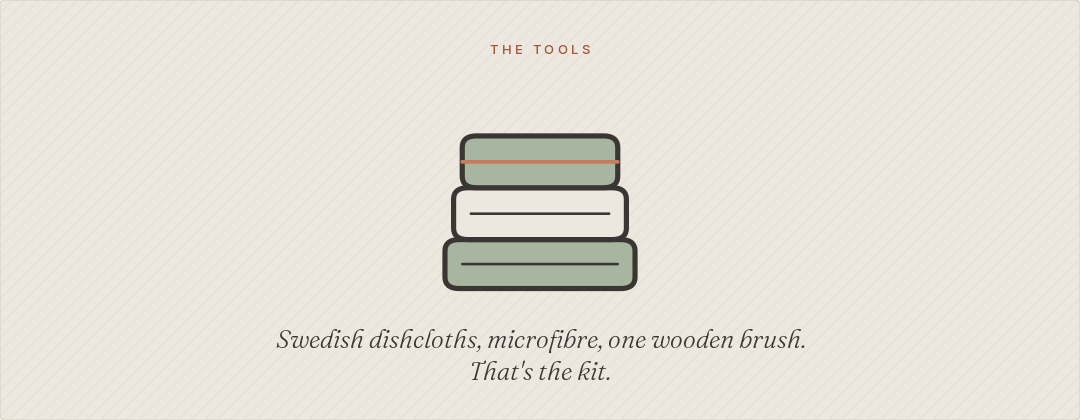
- Swedish dishcloths: they replace paper towels. One cloth = roughly 17 rolls of paper towels over its lifespan.
- A microfiber cloth set in different colors for different rooms (mine: green for kitchen, blue for bathroom, gray for glass).
- A wooden scrub brush set with replaceable heads: Redecker if you want the cult brand, generic versions on Amazon work fine.
- A ceramic or stainless steel toilet brush holder: replaces the plastic ones. Surprisingly nicer to look at.
- A reusable spray mop: the O-Cedar ProMist Max or Bona. You fill the reservoir with your floor cleaner. No more disposable pads or toxic refill solutions.
The honest math
I tracked this for a year because I was curious.
Before DIY:
- ~$30/month on cleaning products (sprays, wipes, paper towels, toilet bowl cleaner, hand soap)
- = $360/year
After DIY:
- ~$80 one-time setup
- ~$8/month on ingredients
- = ~$176 in year one
- = ~$96/year ongoing
Year one savings: ~$184. Ongoing: ~$264/year.
Not life-changing money. But also: I have nicer-looking shelves, no plastic waste, and I know exactly what’s in every bottle. Those things have value too.
The starter shopping list (if you want to begin tomorrow)
If you’re going to do this, don’t try to do everything at once. Start with the bare minimum:
Week 1:
- 2 amber glass spray bottles
- 1 gallon white vinegar
- 1 box baking soda
- 1 bottle Castile soap
That’s enough to make all-purpose spray, glass cleaner, and soft scrub. Total cost: ~$30.
If you stick with it for a month, expand into the full setup. If you don’t, you’re out $30 and have a nice glass bottle you can use for water plants.
A note on essential oils
You don’t need essential oils to make DIY cleaning work. They’re for scent and a small antimicrobial boost. If you skip them, your cleaners still work, they just smell more like vinegar.
If you do use them, two warnings:
- Tea tree oil is toxic to cats. If you have cats, skip it and use lemon or eucalyptus instead.
- More is not better. 10 drops in a 16oz bottle is plenty. 30 drops will give you a headache and clog your sprayer.
Where to start
If this whole post feels like a lot, here’s the truth: it took me about three months to fully transition. I bought one thing at a time, made one cleaner at a time, and replaced products as they ran out.
That’s the simpurely approach: smaller decisions, made once, that compound into a calmer kitchen.
Start with the all-purpose spray. See if you actually use it. If you do, expand. If you don’t, no harm done.
There’s one quiet email a week, and a free swap list if you want somewhere to start. Both live here.
New here? Start with 12 Trader Joe’s Swaps That Quietly Upgraded My Pantry or follow along on Instagram @simpurely.